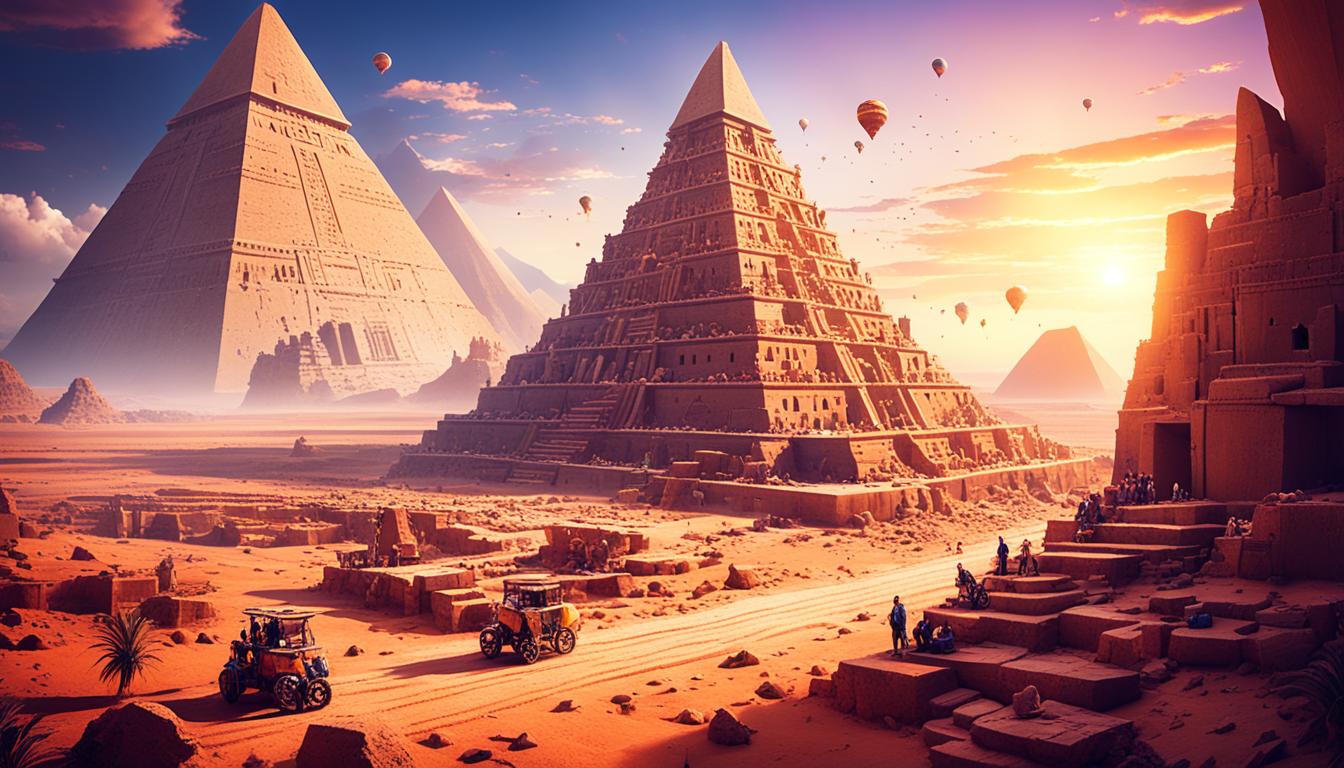
Get ready for an exciting journey through history. We’ll uncover secrets from ancient times that will amaze you. You’ll learn about the mysterious Pyramids of Giza and the incredible skills of early Mesopotamian and Mayan cultures.
Join us as we explore the weird and mysterious history that has puzzled scholars for ages. We’ll reveal the secrets of long-lost civilizations. Be amazed by the strange facts that challenge what we thought we knew about the ancient world.
Unveiling the Enigmatic Pyramids of Giza
The Pyramids of Giza have always fascinated people, standing as amazing architectural wonders. They have lasted for thousands of years. Scholars and visitors are still drawn to them, trying to figure out their secrets.
The Unsolved Mysteries of Ancient Engineering
The size and precision of the Pyramids amaze us. It’s hard to believe the ancient Egyptians built them. They used advanced techniques, aligning the structures with stars and fitting huge stone blocks together perfectly. This has left modern experts puzzled.
Looking into the engineering of the Pyramids helps us understand ancient civilizations better. It shows us the incredible skills of our ancestors and the potential of human creativity.
Uncovering Hidden Chambers and Passages
Under the Pyramids’ big faces, there might be secret passages and chambers. Archaeologists have found tunnels and rooms, but some are still a mystery. Finding these hidden parts excites historians and adventurers. It could reveal more about the ancient Egyptians.
The Lost City of Machu Picchu’s Incredible Masonry
In the Andes Mountains of Peru, the ruins of Machu Picchu, the “Lost City of the Incas,” amaze us. They show the amazing engineering skills of the Inca civilization. This ancient architecture highlights the Inca’s great stone masonry skills. They built this place with stones that fit together perfectly, without mortar.
The Inca engineering at Machu Picchu is stunning. The Inca builders put together stone blocks with great care. This has made a structure that has lasted for centuries. The architectural marvels of Machu Picchu amaze and inspire people from all over the world. They are amazed by the smart ways the Inca built this ancient site.
In the green Andes, Machu Picchu’s ruins show the Inca’s amazing stone masonry and engineering skills. This “Lost City” lets us see the cleverness and skill of the Inca civilization. It leaves visitors in awe of the ancient architecture and the lasting legacy of this incredible ancient culture.
Fun Facts: The Bizarre Rituals of Ancient Cultures
Ancient civilizations had many strange and interesting rituals. They included the detailed mummification of ancient Egypt and the mysterious sacrifices of Mesoamerica. These rituals have always caught the interest of historians and those who love to learn.
Exploring Mummification Practices
The ancient Egyptians were famous for their complex mummification process. This process helped preserve the dead’s bodies. It was thought to help the soul move safely into the afterlife.
They removed the organs, dried the body with salt, and wrapped it in linen. The mummies were then put in fancy coffins with symbols and pictures. This shows how much the Egyptians respected the dead and honored life and death.
Decoding Ancient Sacrificial Ceremonies
Many ancient cultures, like the Aztecs and Mayans, sacrificed humans to please their gods. These rituals often meant taking the heart from a living person. This was believed to give divine favor and power.
Whole communities would watch these ceremonies, seeing them as key to their traditions. While these practices seem shocking today, they show us the complex world of ancient beliefs.
Looking into ancient rituals shows us how diverse human experiences are. They highlight how beliefs can lead to extreme actions. These rituals, though hard to understand, still fascinate us. They help us see the complex nature of being human.
The Groundbreaking Inventions of Early Civilizations
Long before modern technology, ancient civilizations were making big strides in invention and innovation. They created things like cuneiform scripts in Mesopotamia and hieroglyphics in ancient Egypt. These early writing systems helped start the growth of human society.
These ancient inventions and writing systems are the base for many of the advancements we have today. They changed how we communicate and record information.
Tracing the Origins of Writing Systems
The first writing systems came from ancient Mesopotamia and Egypt. They changed how humans could share information and keep records. The cuneiform script used wedge-shaped characters, while hieroglyphics used pictures and sounds.
These writing systems made keeping records and sharing knowledge easier. They helped create complex societies, governments, and trade. Being able to write down ideas and events was key to human progress.
As these inventions and writing systems got better, they led to more progress in areas like math, astronomy, and literature. The impact of these early innovations still shapes our view of history and guides today’s practices.
Unraveling the Secrets of the Mayan Calendar
Step into the captivating world of the Mayan civilization. Here, the Mayan calendar shows their deep knowledge of the cosmos. This tool helped them understand the stars and the cycle of time.
The Mayans were known for their deep astronomical knowledge. They used this to make the long count calendar. This calendar tracked time with great accuracy, following the sun, moon, and planets.
Their skill in ancient timekeeping let them see the universe’s rhythms. This shaped their view of the world and their place in it.
The Mayan calendar is based on cyclical time. It links the past, present, and future together. This was different from other ancient views of time.
By tracking celestial cycles, the Mayans predicted astronomical events with great accuracy. This made them known as skilled astronomers and timekeepers.
The Mayan calendar shows their creativity and deep thinking. As we learn about it, we see their deep bond with nature. They used the universe’s rhythms to understand the world.
Rediscovering the Wonders of Ancient Mesopotamia
In the Middle East, ancient Mesopotamia’s civilizations have always fascinated historians and adventurers. The Hanging Gardens of Babylon stand out as a remarkable wonder from the ancient world. They are a key part of the region’s rich history.
Uncovering the Hanging Gardens of Babylon
The Hanging Gardens of Babylon were a green oasis high above Babylon’s busy streets. King Nebuchadnezzar II built them. He did this to make his homesick wife happy. The gardens had many levels, filled with exotic plants and trees.
There’s a lot of debate about where and how the gardens were made. Ancient Greek historians gave different stories. But new digs and tech have given us fresh clues. These show us the amazing engineering and gardening skills behind the Hanging Gardens.

The Hanging Gardens of Babylon show the best of ancient Mesopotamian design and skill. They were a dream of the Babylonians. Today, they still amaze and inspire us, showing us the greatness of this ancient culture.
The Fascinating Mythology of Ancient Greece
Greek mythology has been a source of wonder for centuries. It tells stories of the ancient gods and heroes that shape our culture. These tales inspire art, literature, and help us understand ourselves better. From Zeus, the mighty ruler, to Hermes, the quick messenger, these gods and their stories still capture our imaginations.
Exploring the Tales of Gods and Heroes
Greek mythology is full of epic stories, tragic love, and heroic deeds. Hercules is famous for his strength and bravery. Odysseus, known for his cleverness and endurance, went on a dangerous journey that inspired the Odyssey. Achilles, the greatest warrior, had a story that shows the impact of fate and human nature.
These stories and creatures still enchant people everywhere. They let us peek into ancient Greece’s rich culture. From the mighty Mount Olympus to the underworld’s dangers, Greek mythology is a treasure of stories and imagination.
Unveiling the Enigmatic Moai Statues of Easter Island
Easter Island, also known as Rapa Nui, is a remote spot in the Pacific Ocean. It’s famous for the Moai statues, which are among the world’s most mysterious ancient wonders. These huge stone figures were made by the Rapa Nui people.
The Moai statues show the skill and culture of the Rapa Nui people. They are huge, measuring from 13 to 33 feet tall and weighing up to 86 tons. These statues were carved from volcanic rock, showing the ancient engineering skills of the islanders.
Experts have many theories about the Moai statues. Some think they honored the island’s chiefs and gods. Others believe they showed the power of the island’s leaders. But their true purpose remains a mystery.
Now, the Moai statues are symbols of the Rapa Nui people’s strength and creativity. They attract visitors from all over the world. These statues continue to inspire and amaze everyone who sees them.
The Incredible Engineering of Ancient Aqueducts
Long before modern plumbing, ancient civilizations knew how to move water over long distances. The Roman aqueducts and the Nabataean water systems show how skilled our ancestors were in engineering.

The Roman aqueducts were huge achievements in ancient engineering. Built during the Roman Empire’s best times, they carried water from far away to cities. These structures had special arched designs that went over valleys and rough land. Their size and complexity still amaze today’s engineers and history buffs.
The Nabataean water systems were just as amazing. They were made by a civilization in what is now Jordan, in a very dry area. The Nabataeans knew a lot about water and built dams, cisterns, and underground channels. This helped them use and share water across their lands. It was key to their survival in the desert.
These ancient aqueducts and systems show how smart our ancestors were. Their engineering skills still amaze and inspire us. They remind us of the great things humans have always been able to do.
Decoding the Mysterious Scripts of the Indus Valley Civilization
The Indus Valley Civilization once thrived in what is now Pakistan and India. It has long fascinated scholars with its mysterious script. This ancient writing system was before Mesopotamia and Ancient Egypt’s scripts. It has been a mystery for centuries, making researchers want to solve it.
Despite lots of archaeological work and many tries to decipher it, the Indus Valley script is still a puzzle. Inscriptions on seals, pottery, and other items give hints, but finding bilingual texts or a Rosetta stone has been hard. Scholars have many theories, from it being a start to modern South Asian languages to a unique way of communicating.
The search for understanding this ancient language goes on. The Indus Valley Civilization was amazing in urban planning, sanitation, and technology. Deciphering its script could reveal their beliefs, practices, and daily life. It would give us a deeper look into a civilization that has intrigued historians and archaeologists.